Most hockey retailers optimize checkout when the real problem is discovery. The customers who know what they want will convert anywhere. Here is where you are actually losing sales.
Seventy percent of online shopping carts get abandoned before purchase. That number gets cited constantly in ecommerce conversations, usually as an argument for better checkout design, cleaner payment flows, or fewer form fields. It is the wrong argument.
The more important number buried inside the cart abandonment data is this: 43 percent of cart abandoners report they were just browsing or not ready to buy, according to Baymard Institute research. These are not customers who got frustrated at checkout. They are customers who were never committed to begin with. They arrived undecided and left undecided. No payment flow optimization fixes that.
Before cart abandonment even enters the picture, consider where most visitors drop out. In sporting goods ecommerce, only 6 to 7 percent of site visitors ever add anything to a cart at all. That means 93 percent of your traffic leaves before reaching the stage you are optimizing for.
Checkout optimization is designed to help the 7 percent. The other 93 percent encountered a different kind of friction, and they left long before checkout was relevant.
That earlier friction has a name: decision paralysis. And in hockey retail, it is endemic.
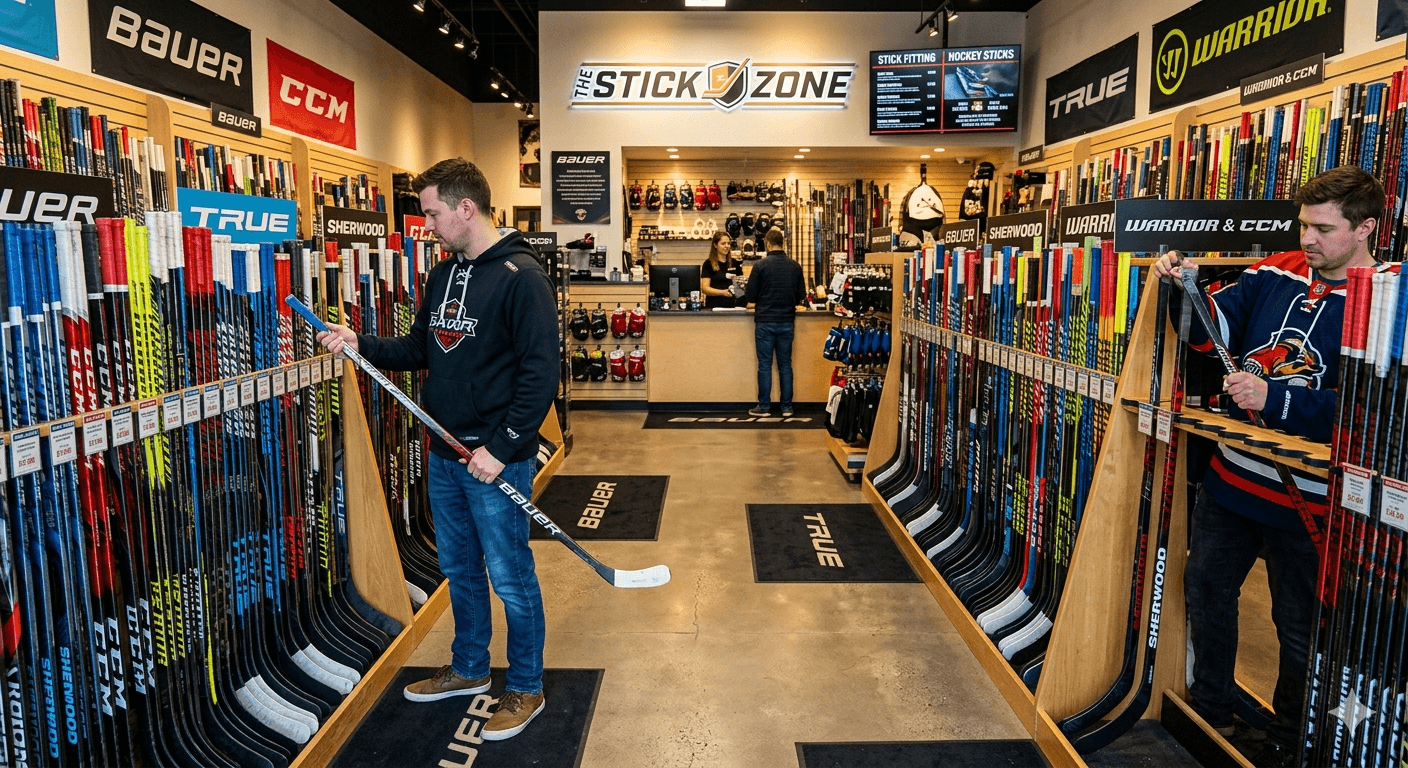
Hockey sticks are one of the most complex equipment purchases in recreational sport. A major retailer running a full catalogue carries anywhere from 100 to 250 senior composite stick SKUs before accounting for flex options, curve options, and hand orientation. When you multiply those variables out, a customer shopping for a stick is navigating thousands of permutations, most of which appear nearly identical to anyone who does not already know what they are looking for.
There is a well-known study by Sheena Iyengar and Mark Lepper that tested jam selection at a grocery store. When shoppers saw 24 jam varieties, 3 percent made a purchase. When they saw 6 varieties, 30 percent made a purchase. The same product, the same customers, the same store. The only variable was choice volume. Conversion dropped by 90 percent when options multiplied.
Hockey stick pages are the 24 jar version of that experiment. Customers who already know they want an 85 flex low kick with a P92 curve will find it. The majority, who are buying their first serious stick, upgrading after a few years, or buying for a kid whose needs they are guessing at, face that shelf of 24 jars and leave.
The framing around guided selling is usually about helping confused customers. That undersells it. Guided discovery does something more commercially valuable: it separates browsers from buyers.
A customer who completes a product finder quiz is not passive. They have answered questions about their playing style, position, flex preference, and budget. They have raised their hand. By the time they see a product recommendation, they are not browsing anymore. They are deciding. That is a fundamentally different commercial moment.
The conversion data on guided selling tools reflects this. Canon deployed a guided product finder and saw 53 percent more conversions and 14 percent more revenue per visitor. Microsoft saw a 25 percent increase in add to cart rate after implementing guided discovery. Trek Bicycles uses a guided tool for their catalogue of 300 plus bikes, a direct structural analog to a hockey stick catalogue. The challenge is identical: highly specified products with overlapping specs, sold to customers across a wide range of expertise levels.
StickMeta's Find My Stick quiz applies this exact model to hockey. Nine questions about height, weight, position, playing level, kick point preference, and budget produce specific stick recommendations from the full catalogue. A customer who arrives uncertain and leaves with a recommendation they feel confident about has a fundamentally different relationship with the purchase than one who sorted by price and guessed.
The best hockey retail experience is a knowledgeable staff member who asks the right questions. What position do you play? What kind of shot do you have? What did you use before and what did you like or not like about it? Those four questions can narrow 250 SKUs to three relevant options in two minutes.
Most online hockey retail experiences offer a filter panel and a price sort. The gap between those two experiences is where you are losing sales. The customer who would have bought with a good conversation leaves without buying because there was no conversation available.
This is not a technology problem. It is a prioritization problem. The guided selling tools exist. The question is whether retailers deploy them.
Checkout optimization is appealing because it is measurable. You can run an A/B test on a button color or a form layout and see results in your analytics within days. The metrics are clear and the cause and effect is clean.
Discovery friction is harder to measure because most hockey retailers do not instrument the browsing journey at a granular level. They see traffic. They see conversion rate. They do not see where in the catalogue experience the 93 percent of non-buyers gave up. They do not have a bounce metric tied to decision paralysis specifically.
But the data on where purchasing decisions actually form is consistent. Customers who reach checkout with high confidence in their selection convert at much higher rates than customers who are still uncertain about the product when they initiate checkout. The confidence is built during discovery, not at checkout. Optimizing checkout without addressing discovery is treating the symptom.
This matters more now than it did five years ago because the information environment around hockey gear has gotten more cluttered, not less. YouTube reviews are sponsored. Brand sites push their own product lines. Reddit threads are anecdotal. Customers who want trustworthy comparative information struggle to find it.
Retailers who solve discovery, who make it genuinely easy for a customer to identify the right stick with confidence before they ever see an add to cart button, are building a different kind of customer relationship than the ones optimizing shipping thresholds.
Understanding how the guided approach works for both players and retailers is covered in more depth on the how it works page. The compare tool is another layer of the same approach: let customers build conviction on their own terms before asking them to buy.
The retailers winning in hockey ecommerce are not the ones with the fastest checkout. They are the ones who have made it easy to decide. That is the problem worth solving first.