The average ecommerce store loses 70% of shoppers before checkout. For hockey retailers selling $300 sticks, that number is even higher. Here is what is driving abandonment and how discovery tools change the outcome.
Hockey sticks are not impulse purchases. A player buying a senior
composite stick is spending $200 to $400 on a piece of equipment they will use
for every practice and game until it breaks. That kind of purchase takes
research. And right now, most hockey retailers are invisible during that
research phase.
The average ecommerce cart abandonment rate across all industries is 70.19%, meaning roughly seven out of every ten shoppers who add a product to a cart leave without completing the purchase. For sporting goods specifically, the sector maintains approximately a 2.1% conversion rate -- meaning fewer than three visitors out of every hundred actually buy.
But for hockey stick retailers, the abandonment problem starts much earlier than the cart. It starts at the product page.
A player researching their next stick faces a fragmented market. Bauer calls a curve the P92. CCM calls the same curve the P29. Warrior calls it the W03. Three different names for the same blade pattern, sold by three competing brands, with no neutral source to explain the connection.
Most players have no idea these are equivalent. They open multiple browser tabs. They dig through Reddit threads. They watch YouTube reviews from sponsored creators. They visit retailer sites that only show their own inventory. After an hour of research, many close every tab and walk away.
That lost purchase is completely invisible to the retailer. They never saw the visitor. They have no record of the intent. They cannot recover it with an abandoned cart email because the player never made it to the cart.
By 2027, 30% of total sports and recreation spending is forecast to happen online. For hockey retailers to capture that shift, they need to be present earlier in the purchase journey -- before the player has already made up their mind or given up entirely.
The In-Store Version of the Same Problem
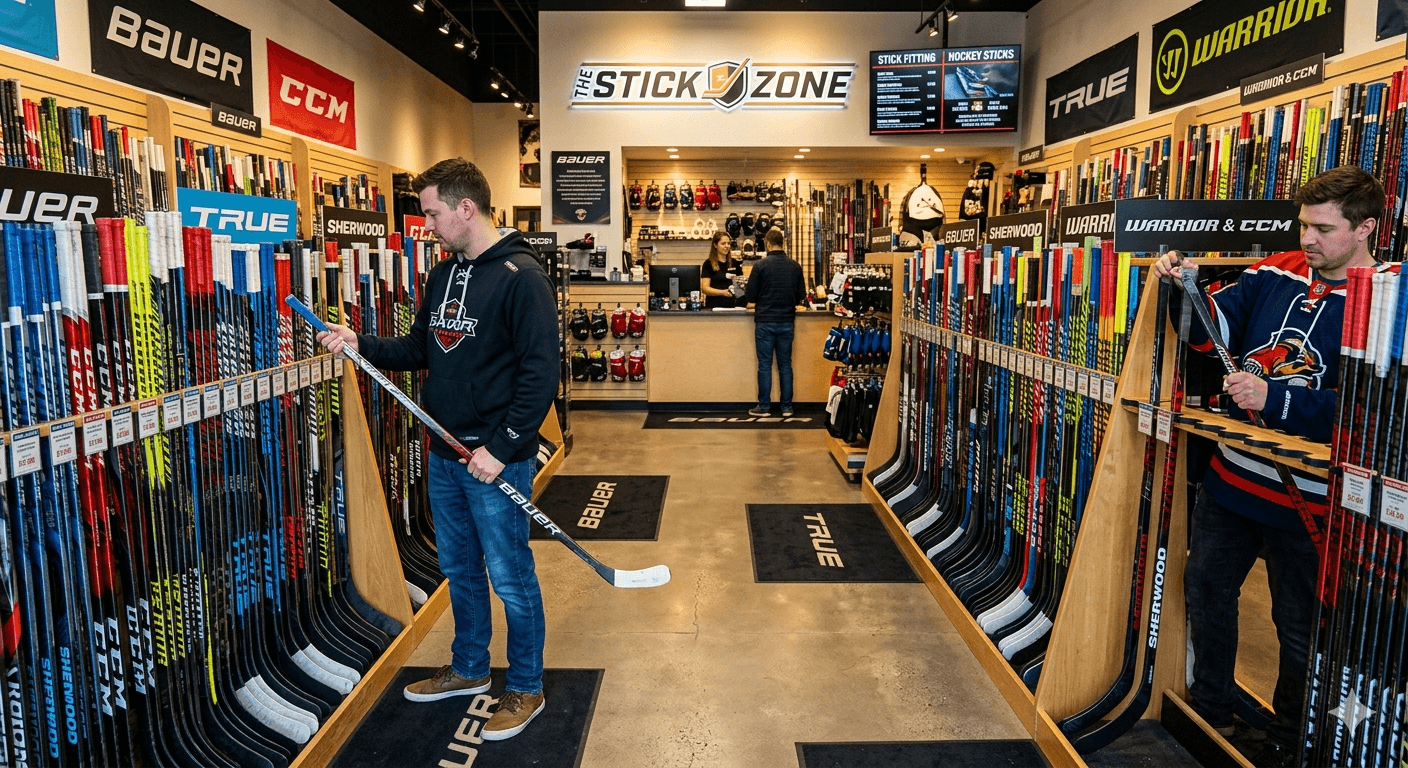
The discovery gap does not only affect ecommerce. Walk into any hockey retailer and you will find a wall of sticks with small tags listing brand, model, and price. The staff can help -- but only so much. Not every associate knows the difference between a low kick and a mid kick point, or why a player switching from Bauer to CCM needs to know that their P88 is roughly equivalent to a P29. During a busy Saturday afternoon, a staff member cannot walk every player through a 20-minute personalized fitting.
The ice hockey stick market was valued at $460 million in 2021 and is estimated to reach $698 million by 2031, with composite sticks driving the majority of that growth. Premium sticks from Bauer and Warrior often exceed $300, making these high-consideration purchases where information quality directly determines whether a sale happens.
A player who leaves your store confused about which curve matches their current pattern is a player who might never come back.
Looks Like
Before a hockey player spends $350 on a stick, they are asking specific questions:
What flex should I use for my height and weight? Use the StickMeta flex calculator to find out.
Does the CCM JetSpeed FT8 Pro come in my curve? Compare it to alternatives here.
What curve does Connor McDavid actually use -- not the one on the retail packaging? See his actual pro stock setup.
Is the P92 the same as the P29? Yes. Here is every brand equivalent.
Right now, most retailers have no answers to these questions on their own websites. The player goes elsewhere to find them. And wherever they go to find the answers is where they are most likely to complete the purchase.
The brands that win the research phase win the sale. This is how Kayak became the default starting point for flight search without ever selling a ticket. This is how NerdWallet built a billion-dollar business without managing a single financial product. They owned the moment before the transaction.
For hockey retailers, owning the research phase means giving players the tools to answer their questions before they leave your site or your store. A cross-brand curve translator. A flex and length calculator. Side-by-side stick comparisons with plain-language breakdowns. These are not features that require a full development team -- they are tools that already exist and can be embedded directly into a retailer's website or in-store tablet display.
Session conversion rates in the sports and recreation ecommerce market averaged 1.59% in March 2026. Retailers who give players the information they need to make a confident decision at the moment they need it do not just improve conversion rates -- they remove the primary reason players leave without buying in the first place.
StickMeta is the discovery layer for the hockey stick market. Players use it to translate curves across brands, compare sticks side by side, find their correct flex rating, and see what NHL players actually use at the pro level.
For retailers, StickMeta offers a white label embed that puts all of these tools directly on your website or in-store tablet -- branded to your store, integrated with your inventory, and designed to keep players in your purchase funnel rather than sending them to a competitor.
The players who are researching their next stick are already out there. The question is whether they find the answers on your platform or someone else's.
See how it works for retailers or explore the tools yourself.